
IPL 2026 Final Match Prediction: RCB vs GT — Who Will Win the Fairplay Battle of Champions?
The IPL 2026 season has arrived at its defining moment, and Fairplay in every department of the game will separate the champions from the runners-up when Royal Challengers Bengaluru (RCB) meet Gujarat Titans (GT) in the final at the Narendra Modi Stadium, Ahmedabad, on Sunday, May 31. This is not merely another T20 showdown — it is a collision between the defending champions and a side that finished level on points with them in the league phase, making it arguably the most evenly contested final in recent IPL history.
RCB arrive as clear favourites, having already dismantled GT by 92 runs in Qualifier 1, posting a record-breaking 254/5 in the process. GT, however, refused to capitulate, bouncing back through the Qualifier 2 route with Shubman Gill’s breathtaking century against Rajasthan Royals. The momentum question is fascinating; one team enters with recent final-winning muscle memory, the other with the hunger of an upset in the making. Our expert prediction leans RCB — but the road to that verdict runs through detailed analysis, numbers, and nuance. Whether you track this match on Fairplay Cricket ID or any other platform, this is one of the most closely contested finals in recent IPL history.
Table of Contents
Match Overview — A Fairplay Showdown for the Ages
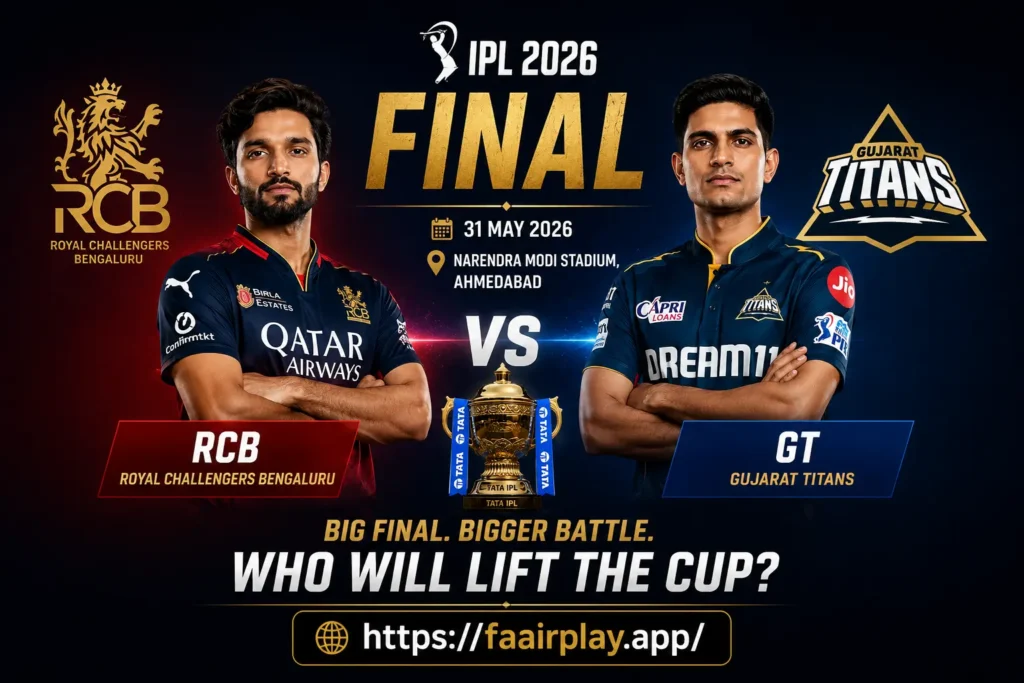
Both RCB and GT finished the IPL 2026 league stage with identical 18 points each, with RCB edging ahead on a superior Net Run Rate to claim the top spot. It is RCB’s fifth IPL final appearance and a chance to become only the third franchise — after Chennai Super Kings and Mumbai Indians — to win back-to-back titles. For Gujarat Titans, this is their third final in five seasons of existence, chasing their second IPL crown after their maiden title in 2022.
The tournament storyline has been compelling throughout. What makes this final particularly satisfying from a Fairplay standpoint is that both teams genuinely earned their places through merit. RCB’s transformation under Rajat Patidar’s captaincy has been the season’s defining narrative: aggressive batting, a disciplined pace attack led by Bhuvneshwar Kumar’s Purple Cap campaign, and knockout-game composure that feels earned rather than inherited. GT’s story is equally gripping — Shubman Gill returning to the kind of form that makes him look like a future great, flanked by an international-quality supporting cast.
Match Timing and Venue Details
Date: Sunday, May 31, 2026
Venue: Narendra Modi Stadium, Ahmedabad, Gujarat
Toss: 7:00 PM IST
Match Start: 7:30 PM IST
The Narendra Modi Stadium, the world’s largest cricket venue with a capacity of over 1,30,000 spectators, will be a cauldron of noise — and the home advantage for GT is real. Ahmedabad will be electric with the Red and Gold brigade packing the stands. The atmosphere, the outfield pace, the dimensions, and the expected dew all factor into how both teams approach this final.
Gujarat Titans Recent Form
GT’s road through the business end of IPL 2026 reflects a team that found its best cricket when it mattered most.
In the five matches leading into the final, GT demonstrated batting depth and bowling variety that would test any side. Their pace duo of Kagiso Rabada (18 wickets in 10 matches at an economy of 9.26) and Mohammed Siraj (back at his former franchise’s nemesis) has been relentless, while Jason Holder’s 17 wickets at an economy of 7.54 gave GT genuine death-over control.
Sai Sudharsan has been the batting revelation of the season — 575 runs in 10 matches at an average of 63.89 and a strike rate of 163.35 — numbers that make him the competition’s most consistent batter. Gill himself scored 457 runs at 171.80 SR, and his 104 off 53 balls in Qualifier 2 against RR (a chase of 215 — now the highest successful chase in IPL history) underlined his big-match temperament.
GT’s middle order has been serviceable rather than spectacular, but Washington Sundar’s all-round impact, Rahul Tewatia’s finishing ability, and Jos Buttler’s pedigree give them genuine flexibility. The concern is the batting’s over-reliance on the top three; if Sudharsan, Gill, and Buttler fire, GT can post or chase anything. If they don’t, the middle collapses quickly.
GT Last 5 Match Results (approximate form):
- Won vs RR in Qualifier 2 by 7 wickets (Gill 104*)
- Lost vs RCB in Qualifier 1 by 92 runs
- Won vs CSK (league stage)
- Won vs SRH (league stage)
- Won vs RR (league stage, 77-run win)
RCB Recent Form — Defending Champions on a Roll
RCB enter this final on the back of arguably their best playoff performance in franchise history. Their 92-run demolition of GT in Qualifier 1 was built on two pillars: Rajat Patidar’s unbeaten 93 off 33 balls (nine sixes, five fours, 86 runs from the last five overs) and a bowling attack that ripped GT’s top order apart inside the powerplay.
Virat Kohli, with 372 runs in 10 matches at an average of 46.5 and a strike rate of 168.32, has been in superb touch without necessarily dominating the scorecards — a sign of a team where the burden is shared. Devdutt Padikkal (328 runs, 165.65 SR) has been outstanding at the top alongside Kohli.
Bhuvneshwar Kumar leads RCB’s bowling with 19 wickets in 10 matches at an economy of 7.64 — his best IPL campaign in years. Josh Hazlewood provides the international pace quality that can trouble any batting order with bounce and seam movement. Jacob Duffy’s three-wicket haul in Qualifier 1 showed RCB have match-winning options even in the lower bowling order.
RCB Last 5 Match Results:
- Won vs GT in Qualifier 1 by 92 runs (254/5 posted)
- Won vs LSG (league stage, 23-run win)
- Won vs MI (league stage)
- Won vs SRH (league stage)
- Won vs DC (league stage)
RCB have been the most clinical side in the tournament’s second half, and that consistency is the bedrock of their status as favourites in this final.
How Both Teams Reached the Final
Gujarat Titans Road to the Final
GT topped the league stage jointly with RCB on 18 points, winning nine of their 14 league games. Their bowling attack — Rabada, Siraj, Holder, and Rashid Khan’s spin — proved difficult to collar at their home ground in Ahmedabad. However, their setback came in Qualifier 1, where RCB’s aggressive batting was simply too much to contain on a sporting Dharamsala pitch.
GT’s response was admirable. They chased 215 with seven wickets and eight balls to spare in Qualifier 2 against Rajasthan Royals at Mullanpur, with Gill’s 104 off 53 as the centrepiece. Sai Sudharsan contributed 58 off 32, and Tewatia finished off the chase in style. That victory set a new record for the highest successful chase in IPL playoff history and sent a clear message to RCB.
RCB Road to the Final
RCB’s league-stage campaign was characterised by ruthless efficiency. They won nine of 14 league games, never losing two in a row, and maintained one of the competition’s best Net Run Rates. The Qualifier 1 performance — a record IPL playoff total of 254/5 — demonstrated that this team knows how to perform on the biggest stages.
Patidar’s captaincy has been tactically sharp; his ability to read match situations and use his bowling resources intelligently has been a key differentiator. The team’s fitness and fielding have been consistently excellent, and there is a quiet belief in the camp that comes from having already done it once, in 2025.
Head-to-Head Record
The RCB vs GT head-to-head stands at 5-4 in favour of RCB from nine meetings. The rivalry has intensified since GT joined the competition in 2022:
- Overall H2H: RCB 5 wins, GT 4 wins
- At Narendra Modi Stadium, Ahmedabad: GT have traditionally been stronger at home in this fixture, having won two of their three matches here
- 2026 season: RCB lead 1-0 (Qualifier 1 win by 92 runs)
- Recent trend: The teams have swapped results alternately in recent seasons, with RCB having had the last word in 2026
The history suggests a tight match is possible, but RCB’s dominant 2026 meeting — where GT’s entire top order was dismantled inside the powerplay — gives the defending champions the psychological advantage.
Pitch Report
The Narendra Modi Stadium surface is one of the most batter-friendly tracks in IPL cricket. The key characteristics for this final:
- Surface type: A balanced mix of red and black soil; the red-soil sections favour free-flowing stroke play, while black-soil areas can offer grip for spinners as the game progresses
- Average first innings score in IPL 2026 at this venue: Approximately 195 runs
- Pace vs spin: Pacers account for roughly 67% of wickets here, using early movement and bounce with the new ball. Spinners like Rashid Khan become relevant from the 10th over onwards
- Chasing trends: Teams have won batting first and chasing almost equally in IPL history at this venue (23-23 from 47 matches before this season), but the evening dew factor consistently tilts the advantage toward the team batting second in night matches
- Boundary dimensions: Square boundaries of 61-72m demand smart placement; straight hitting is rewarded handsomely given the dimensions of the ground
Expect scores in the range of 190-220. The toss will be significant.
Weather Report
Ahmedabad in late May is unrelentingly hot by day, with daytime temperatures pushing past 40°C. For the 7:30 PM start, conditions are expected as follows:
- Evening temperature: Approximately 30-32°C
- Humidity: Around 40-45%, moderate by Ahmedabad standards
- Rain probability: 0% — a full, uninterrupted game is guaranteed
- Wind: Light westerly breeze at 8-11 kmph
- Dew: Dew is likely to develop progressively from around the 12th-13th over of the second innings, making the ball slippery for bowlers and harder for spinners to grip
The dew factor is arguably the match’s most tactically decisive element. As the night progresses, the ball becomes difficult to grip, conventional spin becomes less effective, and targets of 200+ become considerably more chaseable. Both captains are acutely aware of this dynamic.
Toss Prediction
Based on historical toss trends at the Narendra Modi Stadium, the team winning the toss is overwhelmingly expected to bowl first. The reasoning is straightforward:
- Dew makes second-innings bowling increasingly difficult, particularly for spinners like Rashid Khan
- The venue’s batter-friendly track means large first-innings totals can still be chased down under dew conditions
- Both teams have chasing pedigree — GT’s record 215-chase in Qualifier 2 and RCB’s consistent chase record in IPL 2026 make batting second appealing for both
Prediction: Toss winner elects to bowl first. For fans tracking this on Fairplay247, the toss outcome tonight is the most important pre-match development. Given Gill’s tactical consistency and home-ground intuition, GT winning the toss and inserting RCB first would be the textbook play. RCB winning the toss would lead to the same decision.
Probable Playing XI
Gujarat Titans Probable XI
- Sai Sudharsan
- Shubman Gill (c)
- Jos Buttler (wk)
- Washington Sundar
- Nishant Sindhu
- Jason Holder
- Rahul Tewatia
- Rashid Khan
- Arshad Khan
- Kagiso Rabada
- Mohammed Siraj
Prasidh Krishna may replace Arshad Khan depending on pitch conditions.
RCB Probable XI
- Venkatesh Iyer
- Virat Kohli
- Devdutt Padikkal
- Rajat Patidar (c)
- Jitesh Sharma (wk)
- Tim David
- Krunal Pandya
- Bhuvneshwar Kumar
- Jacob Duffy
- Josh Hazlewood
- Rasikh Salam Dar
Suyash Sharma could come in as a spin option depending on how GT’s batting line-up is assessed.
Key Player Battles
Virat Kohli vs Mohammed Siraj
This is the reunion with an emotional undercurrent — Siraj, who built his international career under the RCB banner, now spearheads GT’s pace attack. Kohli’s ability to play the moving ball is world-class, but Siraj knows his former teammate’s game intimately. Siraj will look to angle deliveries into the right-hander’s pads early and challenge the outside edge later. Kohli’s response will be to respect the new ball and shift gears from over 7 onwards. This battle could set the tone for RCB’s innings.
Shubman Gill vs Josh Hazlewood
Hazlewood’s high-arm, back-of-length approach on a good-bounce Ahmedabad pitch is as testing as any opening spell in T20 cricket. Gill is an exceptionally clean timer of the ball, and against pace, his pull shot is a weapon. Hazlewood will seek to deny width and target the top of off-stump, forcing Gill onto the back foot rather than allowing him to drive freely. The powerplay dynamic of this battle will likely determine how quickly GT can build their platform.
Rashid Khan vs Rajat Patidar
Rashid remains the most difficult bowler in T20 cricket to read on a turning surface. Patidar’s left-handed, attack-first approach means he is likely to come after Rashid rather than let him settle. In Qualifier 1, Patidar was devastating against all bowlers, but Rashid was RCB’s biggest concern in the league phase. If Rashid can pin Patidar down through the 10-14 over bracket, GT have a chance to pull the match back.
Additional Battle: Bhuvneshwar Kumar vs Sai Sudharsan
Kumar’s ability to swing the ball under lights, especially in the powerplay, is the counter to Sudharsan’s elegant stroke play. Sudharsan has been the most consistent batter in the tournament, but Kumar’s late outswinger targeting the corridor of uncertainty is a genuine threat early.
Batters to Watch
Gujarat Titans
Sai Sudharsan — The season’s most consistent performer (575 runs, 63.89 average) arrives at the final as the batter in the best form in the tournament. His ability to accumulate without sacrificing strike rate makes him uniquely dangerous.
Shubman Gill — Five IPL centuries, the latest a match-winning 104 in a pressure knockout chase, Gill at his best is unplayable. He will carry the psychological weight of being GT’s match-winner.
Jos Buttler — The experienced Englishman is capable of a 50-ball hundred on a good day, and finals often produce their best from the biggest names.
RCB
Virat Kohli — 372 runs at 46.5 average in 2026; has never won a man-of-the-match award in an IPL final but is overdue for a defining knockout innings at this stage of his career.
Rajat Patidar — His 93 off 33 in Qualifier 1 was a captain’s knock of the highest order. The middle-order anchor who can accelerate from nowhere is RCB’s most dangerous finisher.
Tim David — The Singaporean power hitter has been exceptional in death overs throughout 2026, and the big boundaries at Ahmedabad suit his straight-hitting style.
Bowlers to Watch
Gujarat Titans
Kagiso Rabada — 18 wickets in 10 matches, needs three wickets to reach 150 in IPL history. His pace, bounce, and ability to bowl decisive spells in the powerplay and death make him GT’s most dangerous match-winner with the ball.
Jason Holder — Often the unsung hero, Holder’s 17 wickets at 7.54 economy are a testament to his relentless accuracy. His height generates awkward bounce that disrupts batters at the top and middle of the order.
Rashid Khan — Five fours short of 50 IPL boundaries from the middle overs, Rashid remains the gold standard in T20 spin. On a surface that offers him something from over 10 onwards, he can strangle any batting line-up.
RCB
Bhuvneshwar Kumar — The Purple Cap front-runner with 19 wickets from 10 matches. His knowledge of Ahmedabad conditions from years of playing there, combined with late swing under lights, makes him the most dangerous powerplay bowler in this final.
Josh Hazlewood — International class, experience across every format, and consistent back-of-length hostility. He is RCB’s enforcer with the new ball and the first choice at the death.
Rasikh Salam Dar — 11 wickets from 9 matches; at his best, a difficult proposition for any right-hander. His raw pace and aggression make him a differential.
Captain Comparison
Rajat Patidar (RCB) has been exceptional — tactically intelligent, composed under pressure, and inspirational with the bat at crucial moments. His decision to go ultra-aggressive in Qualifier 1 — essentially telling his team to play without fear — was a masterstroke. He becomes only the second captain after Rohit Sharma and MS Dhoni with the opportunity to win back-to-back IPL titles.
Shubman Gill (GT) is a cerebral captain whose tactical acumen has evolved significantly this season. He led from the front with a century in a record-breaking playoff chase, demonstrating the kind of pressure-absorbing performance that captains are remembered for. His home-ground knowledge and close relationship with Rashid Khan give GT a strategic edge.
In knockout cricket, Patidar has a slight edge — RCB have been the more composed team in crunch moments throughout 2026. But Gill’s willingness to take responsibility with the bat adds a dimension that few captains can match.
Powerplay Analysis
GT batting: Gill and Sudharsan form one of the most dangerous opening pairs in the competition. They will target width from the pacers and look to punish anything short. Expect 50-60 runs from the powerplay if they bat first.
RCB bowling in powerplay: Bhuvneshwar Kumar and Josh Hazlewood form a formidable new-ball combination. Their plan against Gill — targeting the top of off-stump and denying width — will be executed with precision. Getting Gill out inside the powerplay is RCB’s most important tactical objective.
RCB batting in powerplay: Kohli and the opening combination at the top will look to play through the new-ball threat. Against Rabada and Siraj — both of whom use the new ball with pace and movement — the aim is to see off the first four overs and accelerate from 7 onwards.
GT bowling in powerplay: Rabada and Siraj with the new ball are as good a pairing as any in the competition. They will set attacking fields and target both edges aggressively. The powerplay battle could be decisive.
Middle Overs Analysis
The middle overs (7-15) are where Rashid Khan becomes central to GT’s plans. On an Ahmedabad surface that can offer grip and turn from the black-soil sections, Rashid will operate with tight lines and variations. Washington Sundar provides left-arm orthodox spin as a complementary option.
For RCB, Krunal Pandya’s left-arm spin becomes important in controlling GT’s accelerators. The middle overs are where run rates are typically managed through rotation and calculated risk — both teams will have clearly defined batting plans for this phase.
Death Overs Prediction
The death overs (16-20) will likely determine the match. For GT, Rahul Tewatia’s finishing ability, combined with Buttler’s power when set, means they can add 60-70 from the last five overs. Rabada and Holder have been effective death bowlers — concise, disciplined, pace-heavy.
For RCB, Tim David and Patidar in the death have added 70-90 in the final five overs across multiple matches this season. Bhuvneshwar Kumar’s death bowling with yorkers and slower balls has been metronomic.
Tactical Analysis — Fairplay at the Highest Level
RCB’s primary tactical goal is to take GT’s top three — Gill, Sudharsan, and Buttler — inside the powerplay. They demonstrated this clearly in Qualifier 1, where GT’s chase fell apart immediately after their openers went cheaply. A batting collapse of GT’s middle order through Rashid and Tewatia is far more manageable than confronting a set Gill or Sudharsan.
GT’s counter-plan is to exploit the dew in the second innings if they bowl first. With Rashid becoming less effective under dew conditions, GT need their pace — Rabada, Siraj, Holder — to defend or attack late in the match. If RCB bat first and set a total of 190-200, GT will back themselves to chase it with the dew advantage.
The team that manages the dew factor most intelligently will win the IPL 2026 title.
Momentum Analysis
RCB enter with the stronger momentum. Four consecutive wins in the season’s final phase, including the dominant 92-run victory over GT, give the defending champions the psychological advantage. Their batting has been in peak form, their bowling has been consistent, and the squad’s energy levels appear high.
GT, however, cannot be dismissed on the basis of the Qualifier 1 loss. Their comeback through a record-breaking Qualifier 2 chase showed resilience and collective brilliance. Gill’s century in a pressure playoff game was the kind of performance that can reset a team’s psychological state entirely.
The momentum edge belongs to RCB, but GT arrive motivated rather than broken.
Pressure Handling Analysis
RCB were the most composed side in IPL 2025’s knockouts and have replicated that composure in 2026. The squad has experienced final pressure first-hand and knows how to deliver. Kohli, Hazlewood, Bhuvneshwar, and Krunal are all established internationals who handle high-stakes cricket without losing their natural game.
GT have been in three finals in five seasons, winning one. Their playoff experience — particularly Gill’s personal record of performing in knockouts — is a genuine asset. The concern is their middle-order fragility when the top three fail. In final situations, bowling attacks target the top order and rely on that fragility emerging.
Team Strengths and Weaknesses
Gujarat Titans
Strengths:
- A world-class top three in Gill, Sudharsan, and Buttler — any one of them can single-handedly win the match
- International-quality pace attack across all three phases: Rabada, Siraj, Holder
- Rashid Khan — the best spin bowler in T20 cricket when conditions suit him
- Home venue advantage — the Ahmedabad crowd will be vocally behind GT
- Gill’s captaincy composure in high-pressure scenarios
Weaknesses:
- Over-dependence on the top three; middle-order batting depth is a concern
- Rashid becomes far less effective when dew sets in, neutralising their best bowler in the second innings
- Have already lost to RCB heavily in this season’s direct meeting
- Washington Sundar’s all-round contributions are valuable but he is not a true match-winner
RCB
Strengths:
- Defending champions with a settled, experienced core
- Depth in batting — six genuine match-winners in their top seven
- Bhuvneshwar Kumar’s powerplay and death bowling has been the competition’s best
- Patidar’s captaincy has produced a tactically disciplined, aggressive brand of cricket
- Experience of having won this final environment before
Weaknesses:
- Jitesh Sharma’s keeping and batting behind the stumps can be inconsistent
- Spin bowling options beyond Krunal Pandya and Rasikh are limited
- Venkatesh Iyer’s form at the top has been streaky, creating powerplay vulnerability
Fantasy Cricket Insights — Fairplay Picks for the Final
Whether you are playing on Fairplay ID platforms or any other fantasy product, the IPL 2026 final offers a rich range of selection options. Here are the key picks to consider:
- Virat Kohli — consistent run-scorer, high floor, enormous ceiling in finals
- Sai Sudharsan — the tournament’s most in-form batter; near-guaranteed points
- Shubman Gill — three consecutive big-match contributions, captain of the home side
Safe Vice-Captain Choices:
- Kagiso Rabada — reliable wicket-taker, powerplay and death specialist
- Bhuvneshwar Kumar — Purple Cap leader, consistent in all phases
- Rajat Patidar — high ceiling as captain-batter with death-overs finishing ability
Differential Picks:
- Tim David — if he plays a decisive cameo, his fantasy points could be match-winning; often underpriced
- Jason Holder — undervalued despite 17 wickets in 10 matches; could be a difference-maker
High-Risk Picks:
- Jos Buttler — high ceiling but can go cheap; volatile returns
- Rasikh Salam Dar — pace and wickets in bursts, but expensive games are also possible
Small League Picks:
- Devdutt Padikkal (consistent, often slightly underpriced as second opener)
- Washington Sundar (all-round utility may bring solid returns)
Grand League Picks:
- Rahul Tewatia as vice-captain (differential pick — his finishing cameos rarely feature in most squads)
- Jacob Duffy (three-wicket haul in Qualifier 1; could replicate in the final)
Whether you are accessing your team through a Fairplay APK Download or the web platform, the differential picks above offer the best grand-league edge for the final.
High-Risk and Safe Prediction Factors
Safe Factors:
- RCB’s superior batting depth across all seven positions
- Bhuvneshwar Kumar’s proven ability to deliver in knockout matches
- RCB’s 92-run Qualifier 1 win demonstrates that GT’s batting can be dismantled early
- The Ahmedabad pitch’s batter-friendly nature suits RCB’s aggressive approach
- RCB’s mental advantage as defending champions who have already navigated this exact pressure scenario
From a Fairplay analysis perspective, the safe factors overwhelmingly favour RCB — and that aligns with the data-driven predictions available on platforms including Fairplay Casino and sports analytics tools tracking IPL 2026 throughout the tournament.
High-Risk Factors:
- Shubman Gill in devastating form — a repeat of his Qualifier 2 century could single-handedly shift the match
- GT’s home-ground advantage — the crowd, the conditions, the familiarity all aid the Titans
- Rashid Khan on a dry surface in the first innings — if GT bat second and the dew negates him, RCB’s batting advantage narrows considerably
- RCB losing the toss — being asked to bowl first on a surface that tends to produce 190+ could put them under early pressure
Session-Wise Prediction
Powerplay Prediction (Overs 1-6):
Expect 50-60 from either batting side, with 1-2 wickets likely. The new-ball exchanges between Bhuvneshwar/Hazlewood vs Gill/Sudharsan (GT batting) or Rabada/Siraj vs Kohli/Iyer (RCB batting) will be the match’s first critical phase.
First 10 Overs Prediction:
The scoring rate should settle between 8.5-9.5 runs per over. By the end of over 10, expect 90-100 runs with 2-3 wickets down for either side.
Middle Overs Prediction (11-15):
Rashid Khan and Krunal Pandya/spinner will attempt to apply brakes. Expect 35-45 runs in this five-over block with at least 1-2 wickets.
Death Overs Prediction (16-20):
The last five overs should yield 55-70 runs from either batting line-up. Finishers on both sides — Tim David (RCB), Tewatia/Buttler (GT) — are capable of match-changing cameos here.
Innings Projection:
- GT batting first: 185-200
- RCB batting first: 195-215
Match-Winning Probability — The Fairplay Numbers
RCB: 62% — The defending champions hold the advantage due to superior batting depth, proven knockout composure, Bhuvneshwar Kumar’s consistent wicket-taking in the powerplay, and the dew factor disadvantaging Rashid Khan in the second innings if GT bowl first. Their 92-run win over GT in Qualifier 1 was not a fluke but a tactical execution.
GT: 38% — Gujarat Titans are a legitimate threat because of their world-class top three, home-ground advantage, and Rashid’s ability to strangle any batting line-up on a dry surface. Gill’s form heading into the final — a century in a 215-chase — means their path to victory exists clearly. The crowd advantage and GT’s big-match experience in three finals within five years make them far from pushover.
Predicted Score
Scenario 1: GT Bat First
On a typically pace-friendly Ahmedabad track in the first innings, with Bhuvneshwar and Hazlewood targeting the top order, GT can expect early pressure. Sudharsan and Gill — if one stays through the powerplay — can build a platform. Expected total: 185-200.
A score of 195 would be competitive but chaseable for RCB, particularly as dew begins to set in.
Scenario 2: RCB Bat First
RCB’s aggressive batting philosophy against GT’s pace means they will not hold back. With Kohli and Padikkal at the top and Patidar-Tim David at the death, they have the firepower to post 200-220. Expected total: 200-215.
GT chasing 200+ under dew conditions is achievable, as their Qualifier 2 chase demonstrated — but the psychological pressure of needing 200+ in a final is different from needing it in a qualifier.
Predicted Top Scorer
Virat Kohli (RCB) — Kohli’s consistency (372 runs in 10 matches) and his performance history in knockout games make him the most likely top scorer. Finals bring the best out of elite players, and Kohli at his peak in a final, playing for a second consecutive title, is a compelling combination. His ability to pace an innings and explode in the final five overs has been a feature of RCB’s 2026 season.
Alternative: Sai Sudharsan, if GT bat first, is the strongest contender from the GT camp.
Predicted Highest Wicket Taker
Bhuvneshwar Kumar (RCB) — His 19 wickets in 10 matches at 7.64 economy make him the standout bowler in this competition. In night matches at Ahmedabad with swing under lights, he is as difficult to face as anyone in the competition. The powerplay, where most matches are won or lost, is his domain. Expect 2-3 wickets if he bowls his full four overs.
Alternative: Kagiso Rabada, who needs only three wickets for a significant IPL milestone, is a strong contender.
Predicted Man of the Match
Rajat Patidar (RCB) — The RCB captain has been the undisputed match-winner of the 2026 playoffs. His 93 off 33 in Qualifier 1 was perhaps the greatest batting performance in playoff history. In finals, when pressure is at its maximum, players with the mental strength to absorb it and perform — not despite pressure but because of it — tend to emerge as the defining figures. Patidar is that player for RCB in 2026.
Final Winner Prediction
Predicted Winner: Royal Challengers Bengaluru
Why RCB Is More Likely to Win
Current form: RCB have been the most consistent side across the tournament, winning nine of 14 league games and then dismantling GT by 92 runs in their first knockout meeting. Their batting lineup has been in rhythmic, peak form for six consecutive matches. Fans tracking Fairplay Win probabilities will find the data overwhelmingly supporting RCB across batting, bowling, and fielding metrics.
Venue conditions and dew factor: The dew will materially impact the second innings, making GT’s best bowler — Rashid Khan — significantly less effective. RCB’s batting, already deep, benefits from dew conditions that flatten the bowling attack’s ability to deceive with spin. Bhuvneshwar’s ability to hold his line with wrist position under dew gives RCB a bowling advantage regardless of conditions.
Batting depth: RCB have six genuine match-winners in their batting lineup. Even if Kohli and Padikkal go cheaply, Patidar, Tim David, Krunal Pandya, and Jitesh Sharma can post or chase a competitive total. GT’s reliance on Gill, Sudharsan, and Buttler is a structural vulnerability that RCB’s bowling has already exposed.
Death bowling quality: Bhuvneshwar Kumar’s ability to execute yorkers in the final two overs, combined with Hazlewood’s relentless hostility, gives RCB a death-bowling package that concedes consistently under 50 in the last five overs. GT’s death bowling, while quality, is more expensive.
Powerplay performance: RCB’s new-ball attack is the more potent unit for taking wickets inside the six. Dismissing Gill and Sudharsan early has been the proven formula — and Bhuvneshwar and Hazlewood are capable of repeating it.
Pressure handling in knockout games: This matters enormously. RCB have been here before, won here before, and have a captain who thrives in these moments. They know what IPL final pressure feels like, having experienced it in 2025 on the same ground. That institutional memory is an advantage that statistics cannot fully capture.
Spin vs pace matchup: RCB’s batting is better equipped to handle spin, with multiple left-handers in the lineup who can nullify Rashid’s angle. GT’s batting, however, is predominantly right-handed and more vulnerable to Bhuvneshwar’s swing and Hazlewood’s bounce. This matchup analysis is consistent with what Fairplay form analysts have been highlighting through the tournament — RCB’s batting composition gives them a structural edge in this exact type of final.
Middle-order stability: RCB’s middle order — Patidar, Tim David, Krunal — is more consistent under pressure than GT’s — Nishant Sindhu, Washington Sundar, Holder batting deep. When the top order falls, RCB have a more settled, experienced middle group. This depth has been consistently highlighted in Fairplay Win probability models across the tournament.
Final prediction score: RCB 205/5 (20 overs) | GT 178/8 (20 overs) — RCB win by 27 runs
Conclusion
The IPL 2026 final between RCB and GT represents the best version of modern T20 cricket: two tactically sophisticated, genuinely balanced teams, meeting on a grand stage with enough historical context to make every delivery feel weighty. Fairplay — in its truest sense of the best cricket winning — suggests that RCB hold the structural and psychological advantages that matter most in a one-off final.
Gujarat Titans are not here to make up the numbers. Shubman Gill’s form, Sai Sudharsan’s consistency, and the home crowd at Narendra Modi Stadium create a genuine pathway to the title. Kagiso Rabada and Mohammed Siraj can dismantle any batting order on a given day, and Rashid Khan on a dry first-innings surface is the most dangerous spinner in the format.
But RCB’s depth, Patidar’s leadership, Bhuvneshwar Kumar’s bowling artistry, and the defending champions’ hard-won understanding of what it takes to win on the biggest stage gives them the decisive edge. The Fairplay verdict is clear: RCB are the better team in 2026, and tonight in Ahmedabad, that should matter most.
Predicted Winner: Royal Challengers Bengaluru
FAQs
Q1: Who is the favourite to win the RCB vs GT IPL 2026 Final?
Royal Challengers Bengaluru are the favourites, backed by their dominant 92-run win over GT in Qualifier 1, superior batting depth, and defending-champion composure. Their bowling attack, led by Bhuvneshwar Kumar’s 19 wickets, is better equipped for the Ahmedabad conditions. GT are genuine contenders but enter the match as underdogs.
Q2: What is the pitch report for the IPL 2026 Final
The Narendra Modi Stadium surface is a batter-friendly track with an average first-innings score of approximately 195 in IPL 2026. Pacers dominate early, accounting for around 67% of wickets, while spinners — particularly Rashid Khan — become relevant from the 10th over. The Fairplay expectation is a high-scoring match between 190-215.
Q3: Will dew affect the IPL 2026 Final match?
Yes, dew is expected to develop progressively from approximately the 12th-13th over of the second innings. This will make the ball slippery and significantly reduce the effectiveness of spinners like Rashid Khan. Both captains are expected to bowl first after winning the toss to maximise the dew advantage while batting second.
Q4: Who can be the top scorer in the IPL 2026 Final
Virat Kohli (RCB) is the top pick for top scorer, given his 372-run campaign in 2026 and his history of performing in high-stakes matches. From GT’s perspective, Sai Sudharsan — the tournament’s most consistent batter with 575 runs at 63.89 average — is equally capable of producing a match-defining innings.
Q5: Who can take the most wickets in the IPL 2026 Final?
Bhuvneshwar Kumar (RCB) leads with 19 wickets from 10 matches and is the standout bowling prediction for the final. His late swing under lights at Ahmedabad, combined with powerplay aggression, makes him the most likely multiple wicket-taker. Kagiso Rabada — needing just three wickets for an IPL milestone — is the GT contender.
Q6: What is the predicted score for the IPL 2026 Final?
If RCB bat first: 200-215 is projected based on their aggressive batting philosophy and depth. If GT bat first: 185-200 is the expectation, given RCB’s ability to target their top order in the powerplay. Our final prediction sees RCB posting 205/5 and GT falling short at 178/8. Fairplay Cricket ID users tracking the match will find these ranges most useful for pre-match analysis.